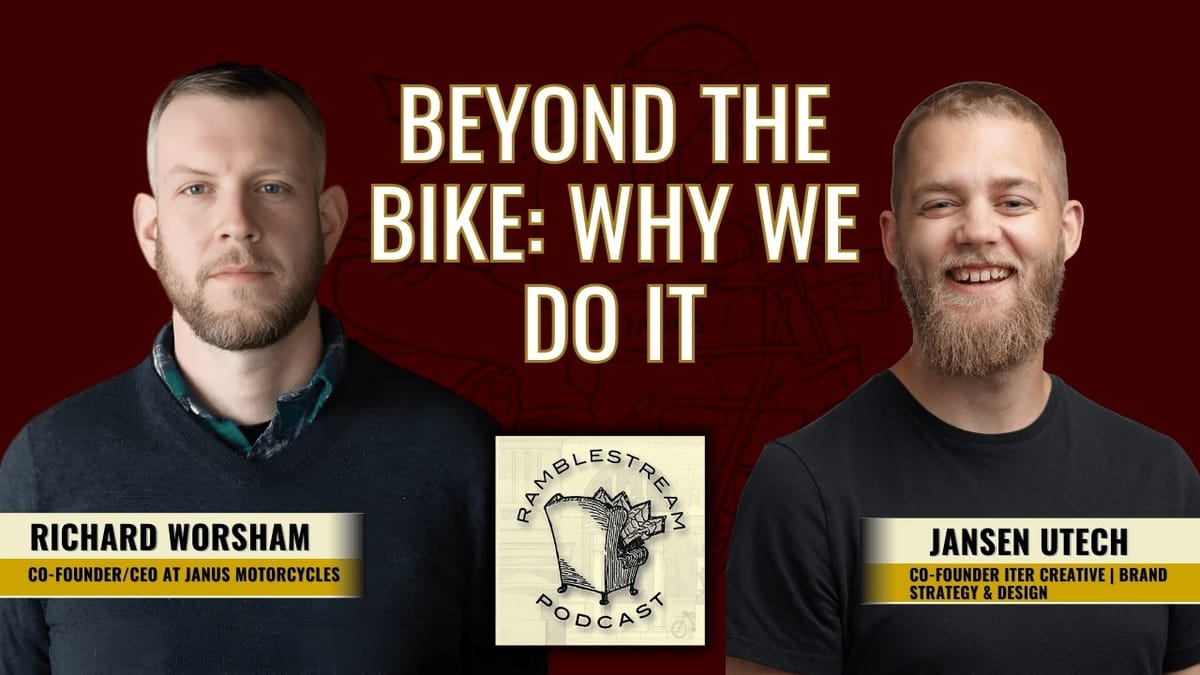
A simple question opens a lot of doors: why do we ride. We chase that answer from multiple angles this week, equal parts poetry, builds, and road-ready practicality, then bring it to life with the energy of a Midwest custom show and the clink of a limited-run rye.
We start with the decision many riders weigh: Janus Halcyon 250 or 450. The 250 is light, immediate, and perfect for savoring 45 mph roads and neighborhood rambles. The 450 brings the Halcyon ethos to higher speeds and longer days with modern suspension and more headroom. You’ll hear how each bike shapes the ride experience, what accessories elevate function and feel, and why sometimes the most “old-school” choice is actually the most liberating.
Craft takes center stage with featured builds: black and gold pinstripes, copper feathers, ducktails, brushed exhausts, highway bars, and clean, minimalist 250 setups that let the lines breathe. We zoom in on details, hand-formed fenders, saddle leather, engraving that looks cast, because those choices add up to identity. Along the way, we share good news for anyone on the fence: spring build slots are open, lead times are sharply reduced, and a simple $250 deposit secures your place. We also pull back the curtain on our WeFunder raise, past $400K and aimed at $1M, to scale production and shorten waits without losing the small-batch soul.
Then it’s celebration time. The inaugural Rye'd or Die custom show with Journeyman Distillery brought out over twenty bikes, from a pristine Sportster to a 1929 Harley whose highway bars echoed modern Janus hardware. The limited “Rye’d or Die” bottle sold out, the room buzzed, and the cameras caught proof that motorcycles and Midwest craft make an honest pair. The best part, though, came from you: rider stories about clarity, solitude, euphoria without a destination, and commutes that turn into rituals. We talk about how repetition creates change, how the same road never rides the same twice, and how motorcycles return agency in a world full of beeps and prompts.
Ride with us, share this one with a friend who needs the nudge, and leave a rating if it moved you. Want more of this energy live? Subscribe and join the Monday stream, bring your questions, your stories, and what you’re sipping.
From livestream #117 - 02/16/26
More About this Episode
Why We Ride: Motorcycles, Meaning, and the Art of Rambling
There is a question that sits underneath every ride, whether we ask it out loud or not: why do we do this?
Why choose two wheels instead of four? Why embrace wind, weather, noise, bugs, and sore muscles? Why trade climate control and convenience for exposure and effort?
The answer is not simple. It is not even singular. But if you ride long enough, you start to realize that motorcycling is not just transportation. It is transformation.
In this episode of the Ramblestream Podcast, we explored the theme of why we ride. Not in a technical sense. Not in a spec sheet sense. But in the deeply human sense. And what emerged from that conversation was something more powerful than horsepower or torque figures.
Riding changes us.
The Difference Between Travel and Rambling
Most people drive with a destination in mind. The car is a tool for moving from point A to point B. Efficiency rules the experience. The shortest route. The fastest time. The least friction.
Motorcycles disrupt that mindset.
When you ride, the journey becomes the point. You find yourself choosing the longer road. Skipping the highway. Turning toward small towns you have never visited. Stopping at a general store simply because it exists.
That shift in mentality is subtle but profound. Riding removes the pressure to arrive and replaces it with permission to explore.
Instead of asking how quickly can I get there, you begin asking what might I discover along the way.
This is what we mean by rambling. It is not aimlessness. It is intentional wandering. Riding to ride. Moving through the world at a pace that allows it to reveal itself.
Clarity, Solitude, and Perspective
When we opened the conversation to our community, a common thread appeared quickly. Riders spoke about clarity. About solitude. About perspective.
There is something about being on a motorcycle that strips away noise. The distractions fall off. The phone is gone. The inbox is irrelevant. Your senses are fully engaged.
You are balancing. Reading the road. Feeling temperature shifts. Smelling the air. Hearing subtle changes in engine tone.
The result is presence.
Clarity does not always come from thinking harder. Sometimes it comes from thinking less and experiencing more. Riding creates that space. The physical act of moving through the world without barriers produces mental stillness.
For many riders, the commute home becomes the best part of the workday. What might be a forgettable drive in a car transforms into an invigorating ritual on two wheels.
The destination does not change. The experience does.
The Habit That Changes You
We have talked before about routines and habits. How transformation often happens not through dramatic moments but through repetition.
Motorcycling is an interesting paradox in this regard. It is the same activity every time. You swing a leg over. You turn the key. You twist the throttle. You lean into corners.
And yet it never feels repetitive in a negative way.
In fact, the more familiar a road becomes, the more you appreciate it. You learn the character of a particular corner. You understand where gravel tends to gather. You feel yourself improving in small, almost invisible increments.
The only way to change yourself is to do something consistently. Riding becomes that steady practice. It builds awareness. Responsibility. Skill. Patience.
It can even reshape how you drive a car. Once you have experienced the world without a cage around you, you never quite return to passive travel. You become more deliberate. More observant. More appreciative of the environment.
Motorcycles cultivate attention. And attention changes people.
Agency in a Prescribed World
Modern vehicles are increasingly prescriptive. They beep when you drift. They steer for you. They warn you. They correct you. They insist.
There is value in safety. But there is also something deeply human about agency.
On a motorcycle, you are responsible. For balance. For line choice. For braking. For awareness. There is no automation buffer between you and consequence.
That responsibility feels alive.
Even if you choose to be perfectly law abiding and cautious, you still feel the option of movement. You feel the openness of possibility. You are not confined to a narrow, controlled channel of travel.
That sense of agency is part of why riding feels like freedom. Not reckless freedom. Not chaos. But autonomy.
You are not just being transported. You are participating.
The Social Alchemy of Two Wheels
Another recurring theme was community.
Many of us did not grow up around motorcycles. We did not inherit the culture. We stumbled into it. And yet, once inside, we found ourselves surrounded by connection.
Motorcycles are social catalysts.
You pull into a gas station and someone asks about your bike. You attend a show and meet builders with radically different tastes. You share a ride with strangers who become friends.
There is always something in common. An engine. A frame. A story.
Riding has a way of pulling people out of their shells. It places you in situations where conversation is natural. Where shared enthusiasm bridges differences.
Even within our own community, the weekly ritual of checking in, sharing builds, discussing gear, or debating models reinforces something deeper. We are not riding alone.
Motorcycles create shared experiences.
Craft, Objects, and Meaning
Part of the joy of riding extends beyond the road. It lives in the objects themselves.
A well built motorcycle. A hand painted fender. A carefully chosen accessory. Even something as simple as a fountain pen that develops patina over time.
We are drawn to things that age well. Things that tell a story as they wear in. Motorcycles are living objects in that sense. They change with us. They accumulate scratches and miles and memories.
Owning a motorcycle is not like owning a disposable device. It is more like stewarding a tool that can outlast you.
That relationship with craftsmanship deepens the experience of riding. You are not just operating a machine. You are engaging with something built with intention.
And that intention invites your own.
Toughness and Euphoria
Let us not romanticize this too much. Riding can be uncomfortable. Cold mornings. Hot afternoons. Dead bugs on your visor. A sore back after a long stretch.
But even that discomfort becomes part of the transformation.
It toughens you up. It reminds you that you are embodied. That weather exists. That the world is not climate controlled.
And then there are the moments of euphoria.
A perfectly carved corner. A stretch of empty road at sunset. The hum of the engine settling into rhythm. The sudden realization that you are exactly where you want to be with no particular need to be anywhere else.
Very few people describe that feeling after driving a car.
The Time Machine Effect
Several riders mentioned something else that resonates deeply. Motorcycles act like time machines.
A modern sport bike can bring back memories of flying jets. A small displacement bike can transport you to childhood mini bikes. A vintage inspired machine can evoke an era you never lived through but somehow understand.
Motorcycles collapse time.
They connect us to earlier versions of ourselves. To stories. To heritage. To mechanical simplicity. They remind us that progress does not always mean improvement in every dimension.
Sometimes it means rediscovering what was already meaningful.
Why We Keep Coming Back
If riding were purely rational, it would not make sense for many of us. Cars are more practical. Safer. Weatherproof.
And yet, we keep choosing two wheels.
We ride for clarity. For community. For agency. For routine. For beauty. For a challenge. For solitude. For joy.
We ride because it makes us better. More attentive. More patient. More connected. More alive.
It is not that riding provides answers to life’s big questions. It is that riding creates the space where those questions can be held differently.
And perhaps that is enough.
Many of those who ramble may very well be lost. But when you are on a motorcycle, sometimes getting lost is precisely the point.