
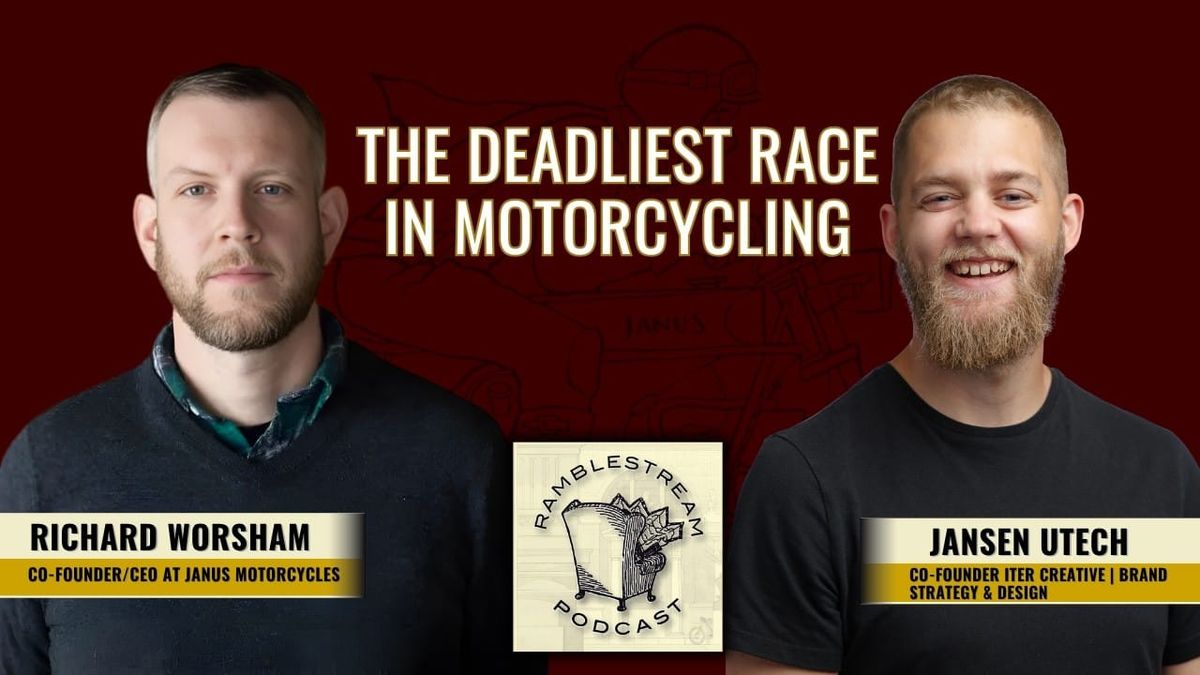
The open road is a massive liability when you are pushing a machine to its absolute mechanical limits. For over a century, the finest line between victory and catastrophe has been drawn on a small island in the Irish Sea, where the regular rules of the pavement simply do not apply. On this episode, Richard Worsham and Jansen Utech dig into the brutal history, terrifying physics, and unmatched legacy of the Isle of Man Tourist Trophy as the qualification week officially kicks off.
We sit down to unpack the transition from historical durability trials to the modern 36-mile mountain course. Our conversation covers the strategic dynamic of racing against the clock rather than a traditional grid start, the wild world of high-speed sidecar racing, and the mental load required to memorize over 200 distinct turns. We also examine how modern racers utilize advanced simulators during the offseason to maintain the precision synapses necessary to survive narrow street curbs and stone walls.
The pursuit of pure speed demands an uncomfortable acceptance of risk, especially when navigating a circuit that has claimed hundreds of lives since 1907. There is an undeniable mental toll on the riders, many of whom balance family life with the reality of clipping apexes inches away from local pubs and spectators. You will walk away from this discussion with a deep appreciation for the specialized rookie training programs, the local culture of Mad Sunday, and the unique heritage that keeps this dangerous motorsport independent of corporate sterilization.
More About this Episode
The Cosmic Threshold and the Open Road
The transition from a quiet field under a blanket of stars to the asphalt ribbon of a racetrack may seem disparate, but they share a common thread: the confrontation with human vulnerability and the pursuit of boundaries. In contemplation of the universe through the poetry of Richard Wilbur, one is reminded of how the grand, kept appointments of the air often evoke a distinct nip of fear. It is that precise threshold where human imagination catches the feel of what lies beyond the safety of schoolbook thoughts.
When transitioning that sense of vulnerability to the physical world, few places embody the edge of human capability quite like the Isle of Man. The island stands as a monument to pure speed, where the traditional constraints of conventional motorsport do not apply. Understanding the magnetism of the Isle of Man Tourist Trophy, or the TT, requires a look into how an island in the Irish Sea became the epicenter of the motorcycle racing world, a sanctuary for true road racing, and a test of psychological and physical endurance that has no equal.
The Genesis of Freedom on the Isle of Man
The existence of the Isle of Man TT is fundamentally an accident of governance and geography. In the early 1900s, Great Britain was gripped by the bicycle boom, which rapidly evolved into the dawn of the motorcycle era. Manufacturers and early owners' clubs, such as those dedicated to Norton, recognized an unprecedented marketing opportunity. They needed to demonstrate the durability, reliability, and sheer capability of these primitive machines.
However, a significant legal roadblock existed. The United Kingdom enforced strict speed limits on public highways, effectively outlawing any form of competitive road racing. To bypass these restrictions, organizers looked across the water. The Isle of Man possessed its own parliament, Tynwald, and its own system of legislative administration. Sensing an opportunity to promote tourism and engineering, the island authorities chose not to enforce the restrictive speed laws of the mainland for specific events, instead permitting public roads to be closed for competitive trials.
The inaugural race took place in 1907. In those early years, the competition was less of a flat-out sprint and more of a reliability trial. Motorcycles navigated a shorter course designed to test mechanical fortitude under grueling conditions. These early trials were not mass-start races where a grid of riders jostled for position into the first corner. Instead, riders competed against the clock, departing at ten-second intervals. This fundamental structure remains a core characteristic of the modern TT. It is a solitary pursuit of speed where a rider is not racing an opponent in a neighboring lane, but rather the unyielding seconds of the stopwatch and the geography of the island itself.
Anatomy of the Snaefell Mountain Course
In 1911, the race migrated to the Snaefell Mountain Course, the definitive 37.73-mile lap that continues to challenge riders today. The sheer scale of the Mountain Course defies the logic of modern, purpose-built circuits like Laguna Seca or Silverstone. A typical short circuit features a handful of corners that can be thoroughly memorized, analyzed, and mastered within a few dozen laps. The Mountain Course, by contrast, features over 200 distinct turns, climbing from sea level up into the mist of the mountains before plunging back down through narrow villages.
The topography introduces environmental variables that no closed circuit can replicate. Due to the immense length of the course, a rider can launch from the start line in bright, warm sunshine, only to encounter dense fog and damp asphalt over the mountain section, before descending back into dry conditions.
The course utilizes everyday public roads, meaning it retains all the structural hazards of normal infrastructure. There are no expansive gravel traps or air-fenced barriers to absorb an error. Instead, the margins are defined by solid stone walls dating back centuries, concrete curbs framing residential sidewalks, and iron drainage grates or manhole covers that become treacherous in changing weather. Subtle changes in camber and unexpected dips can easily destabilize a machine at two hundred miles per hour. At blistering speeds, a minor miscalculation of a hair's breadth can shift a rider from a perfect racing line into the structural facade of a village pub or a roadside hedgerow. The mental load required to process this environment is immense, demanding a synthesis of mechanical skill, absolute focus, and deep spatial memory.
The Evolutionary Split: Grand Prix vs. The Road
For much of the twentieth century, the Isle of Man TT was not an isolated event but a crown jewel of international motorcycle sport. It served as a round of the Grand Prix motorcycle racing world championship, the direct ancestor of modern MotoGP. The world's finest riders, including legends like Giacomo Agostini, Mike Hailwood, and John Surtees, proved their greatness on the roads of the island.
By the 1970s, a profound shift in perspective began to emerge within the racing community. As factory racing motorcycles grew exponentially faster and more powerful, the inherent dangers of the Mountain Course became increasingly difficult to justify. The margin for error had shrunk to near-zero. Following a series of fatal accidents and growing protests from top competitors who argued that the sport had outgrown the infrastructure of public roads, the International Motorcycling Federation stripped the TT of its world championship status after the 1976 event.
From that pivotal moment, Grand Prix racing transitioned permanently to highly regulated, purpose-built circuits with extensive runoff areas and predictable track conditions. The Isle of Man TT, however, did not fade away. Instead, it evolved into an independent, standalone festival, preserving the traditional art of pure road racing. It joined a unique network of events, alongside Irish road races like the Ulster Grand Prix, forming a distinct sub-culture within motorcycling that honors heritage, individual bravery, and a vintage approach to the sport.
A Heritage Written in Speed and Sacrifice
The preservation of road racing has fostered unique dynasties within the sport, where participation feels less like a conventional career choice and more like a family legacy. The most prominent example is the Dunlop family of Northern Ireland. Joey Dunlop remains one of the most successful and revered figures in the history of the event, achieving twenty-six TT victories through a career defined by natural talent and an unassuming personality. His approach to the island reflected a different era: transporting his machinery across the Irish Sea via fishing boats and dedicating his off-season to humanitarian efforts, driving small vans loaded with aid to Eastern Europe.
The tradition was carried forward by subsequent generations, including his nephews, proving that the specialized knowledge required to survive and win on the island is often passed down through bloodlines. This dedication comes with a stark, undeniable reality. The Isle of Man TT is widely regarded as one of the most dangerous sporting events on earth. Since 1907, more than two hundred and sixty competitors have lost their lives on the Mountain Course. It is an environment where the stakes are absolute, drawing a specific breed of competitor who accepts the ultimate risk in exchange for a level of freedom and sensory experience that cannot be found anywhere else in modern sport.
The Art of Preparation and the Modern Era
To safely navigate a 38-mile course at an average lap speed exceeding one hundred and thirty-five miles per hour, modern competitors employ preparation techniques that fuse old-world mentorship with contemporary technology. The qualification period is an essential component of the event, serving as a critical window for riders to re-establish their rhythm and study the shifting nuances of the asphalt.
For newcomers, known as rookies, the learning curve is managed through structured oversight. Experienced, often retired TT riders serve as fluid instructors, guiding the uninitiated through the complexities of the course. During practice sessions, these new riders wear highly visible, bright orange speed vests. This serves as a vital signal to the rest of the field, indicating that the rider is still building their mental database of the course and requires an extra margin of space during high-speed passes.
In the modern era, technology has introduced new tools to this traditional process. Where riders of past generations had to rely entirely on physical laps or driving the course in standard road cars, today's athletes utilize high-definition onboard footage and sophisticated digital simulators. Competitors use these systems during the offseason to keep their neurological pathways sharp, mentally visualizing every throttle input, brake marker, and body transition long before their tires touch the island soil.
This intense preparation culminates in the Senior TT, the final and most prestigious race of the festival. Reserved for the premier one-thousand-cc machinery and the most experienced competitors, the Senior TT demands six full laps of the Mountain Course. Covering over two hundred miles of high-speed riding, it stands as the ultimate test of physical stamina, mechanical reliability, and mental endurance.
The Unifying Culture of the Island
Beyond the raw physics of speed, the Isle of Man TT is defined by its unique atmosphere and accessibility. Throughout most of the track, there are no grandstands or security fences separating the audience from the action. Spectators sit directly atop low stone walls or stand at the edges of country hedges, watching motorcycles flash past just inches away. The visceral sensation of displaced air, the mechanical roar of the engines, and the blur of leather and steel create an immersive experience that bridges the gap between athlete and enthusiast.
This spirit extends to traditional events like Mad Sunday, a scheduled period during the festival where the mountain section of the course is opened to the public as a one-way road. Motorcycle enthusiasts from across the globe have the opportunity to ride the same tarmac as their heroes, experiencing the sweeping lines of the mountain climb firsthand. It transforms the entire island into a celebration of two-wheeled engineering and camaraderie, drawing thousands of machines onto the ferries crossing the Irish Sea.
From small, lightweight fifty-cc vintage machines like our own Janice Halcyon models to the cutting-edge superbikes of the modern era, the Isle of Man remains a sacred destination. It is a place where time slows down even as the machines move faster, preserving a pure, uncommercialized expression of the passion for riding. The event reminds us why we choose to explore the open road: to challenge our limits, to experience the world with absolute clarity, and to find our own path, even if it means getting beautifully lost along the way.