
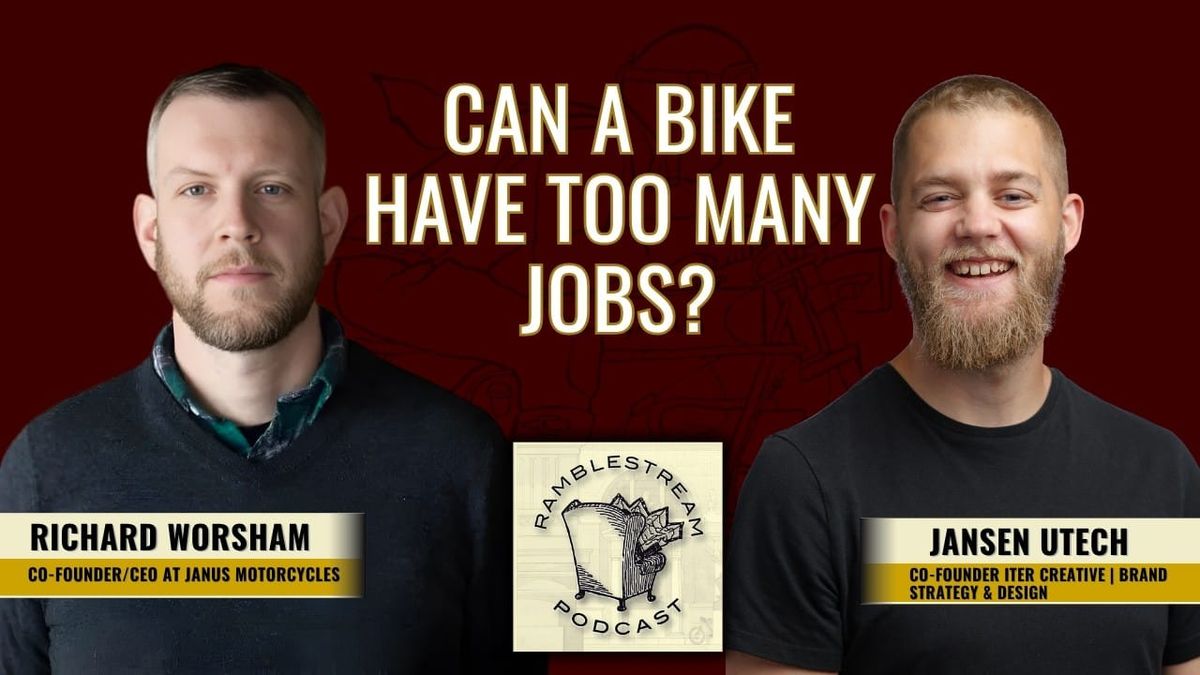
The pursuit of the "do-it-all" vehicle is a profit-draining compromise that leaves riders with sterile, over-engineered machines trying to please everyone at once. In a modern market obsessed with turning every sports car into a crossover and every motorcycle into a heavy, dual-sport SUV, we are losing the raw joy of riding a machine built with singular intentionality. In this episode, hosts Richard Worsham and Jansen Utech break down why fighting for hyper-focused, purpose-built design matters right now in an industry bogged down by commercial compromise.
We sit down to unpack Richard's recent weekend running the gauntlet on everything from a high-performance sport bike to a utilitarian dual-sport, mapping out exactly how a machine’s mechanical layout dictating your mental presence on the road. The conversation digs into the historical design iterations of leather saddlebags, the upcoming 250th anniversary custom builds, and the physical reality of riding bandwidth versus the illusion of comfort. We also explore the unique manufacturing hurdles of navigating erratic global supply chains and erratic parts delivery while maintaining artisanal quality at headquarters.
The hard reality of vehicle design is that when you force a tool to carry every job, you strip it of its soul and its ability to deliver genuine excitement. A great bike shouldn't strive to be a sensible commuter option for rainy highway logistics; it should be an uncompromising vehicle optimized for the exact range of experience it was forged to dominate. You will walk away from this discussion with a sharper framework for evaluating your garage based on raw mechanical purpose rather than speculative, jack-of-all-trades marketing promises.
If you care about motorcycle aesthetics, uncompromised chassis engineering, and the unfiltered lifestyle of two-wheeled travel, you’ll get a lot from this conversation. Subscribe to the Ramblestream podcast and share this episode with a fellow rider who respects the craft. We want to hear from you in the comments below: what is the most useless piece of "practical" compromise you have ever seen bolted onto a motorcycle?
More About this Episode
The Purposelessness of the Do It All Vehicle
There is a growing trap in modern manufacturing that mirrors a larger trap in modern life: the demand that everything must do everything at once. We see it everywhere. We see it in marketing campaigns for crossovers and electric SUVs, and we see it in contemporary automotive journalism. Consumers are told they should want a minivan that handles like a track ready sports car, which can also tow a multi ton trailer through a muddy field while delivering optimal, eco friendly efficiency.
We are constantly pushed toward the illusion of the ultimate all rounder. Yet, when a machine is forced to occupy every single use case simultaneously, it often loses the very soul that makes it worth piloting in the first place.
This reality became starkly apparent to me over a recent weekend of back to back riding. I spent several late nights in the garage, hunched over an old Ducati that is new to me, sorting out its vitals: changing the belts, swapping the oil, mounting fresh rubber, and replacing the spark plugs. Once the machine was roadworthy, I geared up completely with armored jeans, heavy riding boots, and a fresh helmet, fully prepared for an intense, focused experience.
A few miles into the trip, after realizing my jacket pocket had been left unzipped and my wallet was gone, I had to pivot. After a frantic and ultimately successful search, aided by a genuinely kind local rider named Norman who spotted the wallet on his Harley Davidson, I had to swap keys. The Ducati blew a fuse, leaving me with a dead headlight, so I hopped directly onto a Kawasaki KLR 650 to finish my run.
Sliding from the cockpit of a specialized Italian sport bike directly onto a utilitarian dual sport tractor was an aggressive lesson in vehicle philosophy. It forced an immediate question that every enthusiast eventually face: can a motorcycle try to have too many jobs?
The Illusion of the All Rounder
The Kawasaki KLR is the quintessential poster child for the jack of all trades, master of none approach to engineering. It is an incredibly popular motorcycle precisely because it is marketed as a do it all machine. It can chug down an asphalt highway, it can navigate a gravel fire road, and it can survive a singletrack trail. It is rugged, reliable, and profoundly practical.
However, by designing a machine to occupy the middle ground between two wildly divergent worlds, you inevitably introduce deep compromises.
When you try to make an adventure platform or a dual sport do everything, you lose crisp performance. The KLR is reasonably heavy, low on power, and aesthetically utilitarian. It is built out of practical clothing. It functions well enough on the street and well enough in the dirt, but it lacks the razor sharp focus of a dedicated road machine or the lightweight agility of a pure dirt bike. It is an honorable tool, but its very existence is bogged down by the weight of absolute practicality.
When a vehicle attempts to satisfy every engineering metric at once, it risks turning into a lifeless crossover. True excitement does not live in a spreadsheet of balanced compromises; it lives at the extremes of intentional design.
The Errand of Pure Focus
On the exact opposite end of the spectrum sits a machine like the Ducati. This is a motorcycle built with an uncompromising, singular intent: peak performance and pure exhilaration. Riding it requires an entirely different cognitive load. The ergonomics are aggressive, with hands placed close together and your body weight thrown forward over the tank. The suspension is incredibly stiff, tuned beautifully for smooth asphalt and track apexes, but punishing over real world imperfections. Crossing a set of railroad tracks on a sport bike requires shifting down to a crawl to keep the entire chassis from violently shaking apart.
The bandwidth of enjoyment on a highly specialized sport bike is intensely narrow but deeply intoxicating. Its power band thrives on rapid acceleration and high speed cornering. When you are cruising down a straight state highway at standard speeds, the machine feels impatient, constantly demanding to know where the next vehicle is to pass or where the next clear stretch of tarmac lies. You cannot easily take your eyes off the pavement to look at the landscape; the sheer speed and geometry of the bike require an intense, unyielding focus just to stay upright and alive.
It is a magnificent tool for a specific job, but it is utterly useless outside of that thin sliver of operational harmony. It does not want to rumble through town, it hates being stuck in first gear, and it possesses a turning radius that makes an F 150 look nimble.
Expanding the Bandwidth of the Everyday Ride
This contrast is exactly why our approach at Janice Motorcycles focuses on a completely different interpretation of purpose built design. When Jansen Utech and I look at the architecture of models like the Halcyon 250 or the Halcyon 450, we are choosing to build a machine with a dedicated, intentional purpose. To the uninitiated observer, a vintage styled, hardtail motorcycle might seem like a single function vehicle, meant only for fair weather weekend jaunts where you have no intention of going fast.
In actual practice, the operational bandwidth of a Halcyon is remarkably broad.
Because the machine is designed to thrive exactly where most riders spend the vast majority of their time, it unlocks a massive spectrum of daily enjoyment. The upright, neutral seating position naturally pulls your hands up and relieves the weight on your wrists. Your field of vision widens completely. You are no longer staring down a narrow corridor of blacktop waiting for the next corner; you are actively engaging with the world around you.
Whether you are navigating a cobblestone city street, rolling along a two lane country road, or dropping onto a packed gravel lane, the experience remains thoroughly engaging. The light weight makes the machine incredibly nimble, allowing for a tight turning radius and effortless handling that heavy, do it all adventure touring rigs simply cannot match. You can effortlessly skim across rough patches because the bike is balanced for that specific operating envelope, rather than trying to carry the massive structural suspension required to jump a sand dune.
Intentional Architecture over Total Utility
This philosophy extends directly into how we approach the physical components of our builds. Every piece of hardware, every scrap of leather, and every structural line must serve the core identity of the motorcycle. When we first designed the saddlebags for the Halcyon, I sketched the profile of the luggage before the physical prototype of the bike was even completed. I wanted a form factor that integrated seamlessly with the rear radius of the wheel, rather than slapping generic, square metal panniers onto a beautiful frame. Big utility boxes might hold more cargo, but they destroy the visual harmony and balance of the machine.
Our leather goods, from the custom seats to the battery straps and the slanting saddlebags, are constructed by Mark, a local Amish craftsman who has worked with us since our early days. Every piece of laser cut aluminum hardware and every buckle we developed with Devon back in 2014 was built because we wanted simple, elegant, tactile components that could be broken in over years of use.
We are currently finishing up a special 250th anniversary edition of our builds, which will introduce an array of traditional leather tassels on the grips, seats, and bags. While some riders might view fringe or tassels as purely ornamental, there is a historical, joyful expression in those details. It is a nod to a time when vehicles were expressive, tactile, and unashamedly distinct. It is a deliberate pivot away from the cold, sterile plastic panels that dominate the modern, mass produced market.
The Joy of the Single Purpose Tool
When you remove the burden of absolute practicality, you free a machine to be exceptional at its true calling. We do not design motorcycles to compete with a clapped out sedan or a standard commuter vehicle. If your solitary goal is hyper efficient, weatherproof utility, a basic four wheeled commuter car will always do the job with less hassle.
We build motorcycles to enhance the specific experience of rambling. We want tools that possess an intentional, clear purpose. Consider a simple maritime analogy: do you want a massive, multi ton sailboat capable of crossing the Atlantic Ocean, or do you want a small, light dinghy that you can throw into a local lake on a sunny afternoon? The large ocean liner is technically more capable on paper, but which one are you actually going to sail more often? Which one will bring you closer to the water and deliver genuine adventure on an ordinary Tuesday?
The answer is self evident. True fulfillment on two wheels comes from choosing a machine that embraces its true identity without trying to mask its limitations. When we try to make one motorcycle serve as a highway cruiser, an off road explorer, a daily commuter, and a track weapon, we end up with an uninspired compromise. It is far better to fill your garage with distinct, single purpose tools that understand their jobs perfectly. May your collection grow, may your destinations remain beautifully open ended, and may your tools always be crafted with a clear, undeniable purpose.