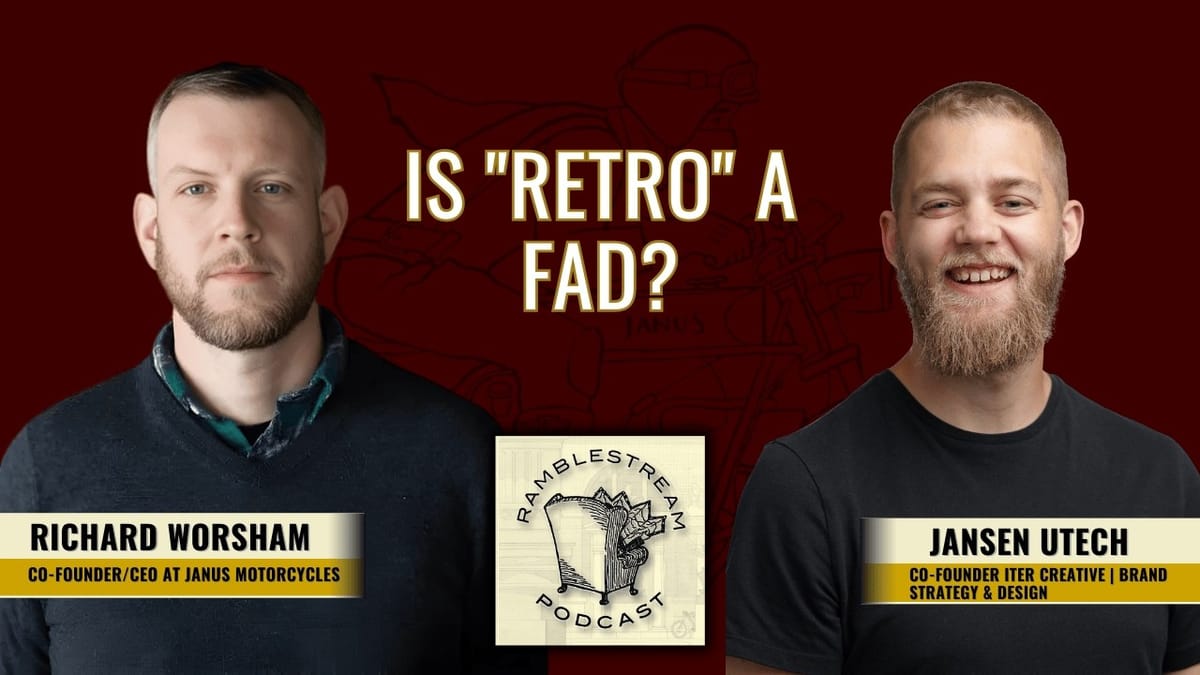
A lot of motorcycle talk gets stuck on horsepower, specs, and whatever the algorithm says is “next.” We take a different route here, starting with a new way for you to be part of the show: our Ramblestream voicemail line, where you can leave questions any time and we’ll play selected messages on a future stream. Then we do what we do best: wander into meaning, memory, and why riders keep certain “things” long after they’ve stopped being useful.
That question gets real when we read Lord Byron’s “Epitaph To A Dog” and then hold up a literal relic: an old, beat-up helmet covered in moped stickers. It’s the perfect bridge into the practical side of riding too, from answering where Janus engines are made to introducing a simple helmet lock designed to keep “helmet goblins” from walking off with your gear. We also share company updates, including the Janus Motorcycles WeFunder push, spring build slots with reduced deposits, and the new Founder Fridays tour format that lets you see the shop running in real time.
The big topic, though, is retro motorcycles. We unpack what “retro” usually means in today’s market, then put real bikes on the table: Ducati’s Paul Smart-inspired Formula 73, the MV Agusta Superveloce, the Benda Napoleon Bob, the Indian Chief Vintage, and a Harley-Davidson cafe racer concept nodding to the XLCR. We’re not just judging looks. We’re asking what still delivers that analog riding experience.
Subscribe for more motorcycle design talk and rider philosophy, share the show with a friend who misses simple machines, and leave a rating so more ramblers can find us.
From livestream #120 - 03/09/26
More About this Episode
The Retro Question: Modern Fads vs. Mechanical Soul
The word retro is thrown around in the motorcycle industry today with such frequency that it has almost lost its meaning. In the current market, retro typically serves as shorthand for a specific aesthetic formula: old looks paired with new function. It is a trend, or perhaps an accelerating fad, that seeks to conjure up a feeling of the past through a sort of mechanical makeup. Whether it is a modern sport bike dressed in 1970s livery or a cruiser with vintage lines, the industry is increasingly focused on nostalgia. But here at Janus, we have always aimed for something deeper. We believe there is a fundamental distinction between a bike that just looks old and a bike that captures the mechanical soul of the riding experience.
In a recent conversation on the Ramblestream, we unpacked this concept of retro, looking at everything from high end Italian design to the practical evolution of our own builds. The goal was to understand where the line is drawn between a surface level trend and a truly visceral, analog connection with a machine. I want to explore why we find ourselves so drawn to these older forms and whether the modern industry is actually delivering on the promise of the past, or if they are just selling us a well packaged illusion.
The Problem with Nostalgia as Makeup
When most consumers think of a retro motorcycle, they are thinking of a vehicle that captures the shell of a vintage bike while hiding a modern, highly refined core. There is a desire for the golden nostalgia of an era many riders never actually experienced, the 1960s, 70s, or even the 20s. This is often achieved through styling cues: a sea green frame, a specific tank stripe, or a round headlight with a classic X taped across it. It is a form of conjuring. We use these visual shortcuts to spark a sensation of a time when things felt simpler, more direct, and more dangerous.
While these bikes are often beautiful, they frequently miss the visceral sensation that makes an old machine what it is. An old 1970s moped or a 1920s style motorcycle offers a direct connection to the road. You might call it uncomfortably low performance or even unacceptably slow by modern standards, but it possesses a character that enhances the experience. It requires you to be present. You have to work with the machine, listen to its tiny mechanical song, and understand its quirks. Modern retro bikes are often so refined and remote that they remove the rider from that immediate experience. They offer the look of a cafe racer without the grit, vibration, and raw feedback of actually riding one.
This "makeup" approach to design suggests that the past is something to be looked at, rather than something to be felt. When a manufacturer takes a high performance sport bike and puts a vintage fairing on it, they are giving you the costume of a rider from forty years ago without the physical reality of the machine they actually rode. It is a dilution of the experience, trading the soul of the ride for the convenience of the modern age.
The Janus Case: Constraints and Character
We often argue that Janus motorcycles are not retro in the traditional sense, even though they look the part. We do not use old styling as a costume for a modern, high horsepower engine. Instead, our design is a byproduct of the way we manufacture. We talk a lot about constraints. Our small scale manufacturing process and our focus on simple, durable engines limit us in ways that actually provide flavor. When you work within constraints, you are forced to find beauty in simplicity.
Our bikes are archaic in some regards because they are built to be simple, manageable, and analog. We are not trying to win a horsepower war or pack the bike with traction control and digital rider aids. Why? Because those things are not necessary when you are focused on the fifty five mile per hour experience. We believe that a motorcycle is at its best on a two lane road, taking twisty turns and stopping to talk to people. We are retro only insofar as we do a better job of remembering what motorcycles are actually about than the major manufacturers do.
By focusing on the limit that riders actually experience every day, rather than a theoretical performance limit that requires computers to manage, we create a more immediate relationship with reality. We don't want a bike that filters the road for us; we want a bike that invites us to feel every inch of it. Our manufacturing process, which involves hand welding frames and manual pinstriping, creates a unique machine that is a direct reflection of the people who built it. That is where the soul comes from, not from a marketing department, but from the actual hands that shaped the metal.
A Spectrum of Retro: Analyzing the Current Market
To see how the rest of the industry handles this, we can look at a few recent examples. Each takes a different path toward the retro goal, and each reveals something about our current cultural obsession with the past.
First, consider the Ducati Formula 73. This is a beautiful replica livery of the Paul Smart 750 from the early 70s. It uses the sea green frame and silver tank to conjure up the feeling of endurance racing at Imola. However, it is a modernized version of that pattern. It is an inspired piece of design, but it is ultimately a modern machine in vintage clothes. It captures the look of the endurance racer, but none of the raw, detuned mechanical nature of the original. It is a stunning tribute, but it is still a modern Ducati at heart.
Then there is the MV Agusta Superveloce. This bike takes Italian flair to another level. It is very modern, yet it leans heavily into fairing designs that look back at the past. It is an extreme example of taking a high performance machine and giving it a classic flavor. It is a gorgeous bike, particularly in the white and gold MV colors, but it still represents that "makeup" philosophy. It is a modern sport bike that has been sculpted to remind you of the past, even as it operates at a level of performance the past could never dream of.
The Benda Napoleon Bob is a more interesting case. This Chinese made V twin doesn't seem to be intentionally mimicking a specific historical model. Instead, it focuses on what makes a motorcycle look good, which often involves timeless design elements like a low silhouette and balanced proportions. It is forging a new path by honoring universal aesthetics rather than specifically mimicking a museum piece. This suggests that good design is cross-temporal, certain shapes and forms simply look "right" to the human eye, regardless of the decade.
Finally, the Indian Chief Vintage is a masterclass in making new technology look old. With its skirted fenders and polished engine, it channels the silhouette of late 30s and early 40s automotive design. It is technically superior and highly refined, yet it works incredibly hard to hide that refinement behind a vintage facade. It is almost the opposite of a Janus; while we embrace the simple, older mechanical nature of our bikes, Indian uses world class engineering to simulate an older form. It is a successful piece of art, but it still maintains that distance between the rider and the raw mechanics.
The Value of the "Retired" Thing
The concept of retro also ties into how we value objects as they age. We often keep things that are past their expiration date, an old snowmobile helmet from the 80s covered in moped gang stickers, or an heirloom jacket that has worn out. These objects transform from tools into art or historical representations. They are cherished because they carry a story.
In the same way, a motorcycle with mechanical soul is a thing you keep even when it is no longer the fastest or most efficient tool available. It becomes a piece of history that you can still interact with. The longer a machine has been retired from the pursuit of modern performance, the more it can be cherished for its intrinsic character. We build Janus bikes to be those kinds of objects, machines that will still matter thirty years from now because they were never trying to be modern in the first place.
When an object is no longer useful as a high performance tool, its value shifts to its story and its aesthetic. By building bikes that embrace an older mechanical philosophy from day one, we are creating heirlooms that don't need to wait fifty years to be considered "classic." They are designed to be cherished for their character right off the assembly line.
The Practicality of Simple Tech
Sometimes, the smartest technology is the stuff we figured out decades ago. A perfect example is the simple mechanical helmet lock. In a world of apps and electronics, a turn key lock that keeps your helmet on your bike is a revolutionary return to form. It defeats the helmet goblins without requiring a software update or a battery. It is a simple mechanical solution to a human problem.
This philosophy extends to our engines. Our 250 and 450 engines are chosen because they represent a high durability, low maintenance approach to motorcycling. Based on classic Honda designs from the 70s, these engines are bulletproof. They are designed to be easy to work on and even easier to enjoy. Country of origin doesn't matter as much as the quality and simplicity of the design. We aren't looking for the most horsepower; we are looking for the most reliability and the most immediate mechanical connection. These are analog solutions for riders who want to spend more time on the road and less time plugged into a diagnostic computer.
Final Thoughts: Distilling the Experience
Ultimately, the future of riding isn't about how much makeup we can put on a modern sport bike. It is about distilling the experience down to what actually provides flavor. If you distill a liquid, you lose some of it, you lose the water of unnecessary features and remote performance, but you gain a concentrated essence.
We want to get away with something when we ride. We want to feel like we are transforming ourselves on the road, leaving the digital noise of the modern world behind. That connection happens best when the motorcycle is an honest partner in the ride, not a computer that filters the road for you. We ride because we want to ramble, to talk to people, and to feel the wind without a dozen electronic systems telling us how to do it.
Whether you call it retro, vintage, or analog, the goal is a motorcycle that feels like a shared secret between the rider and the machine. We are not just building bikes; we are building experiences that honor the history of motorcycling while offering something completely unique for the modern world. The ride is what matters, and the simpler the machine, the more the ride can shine.