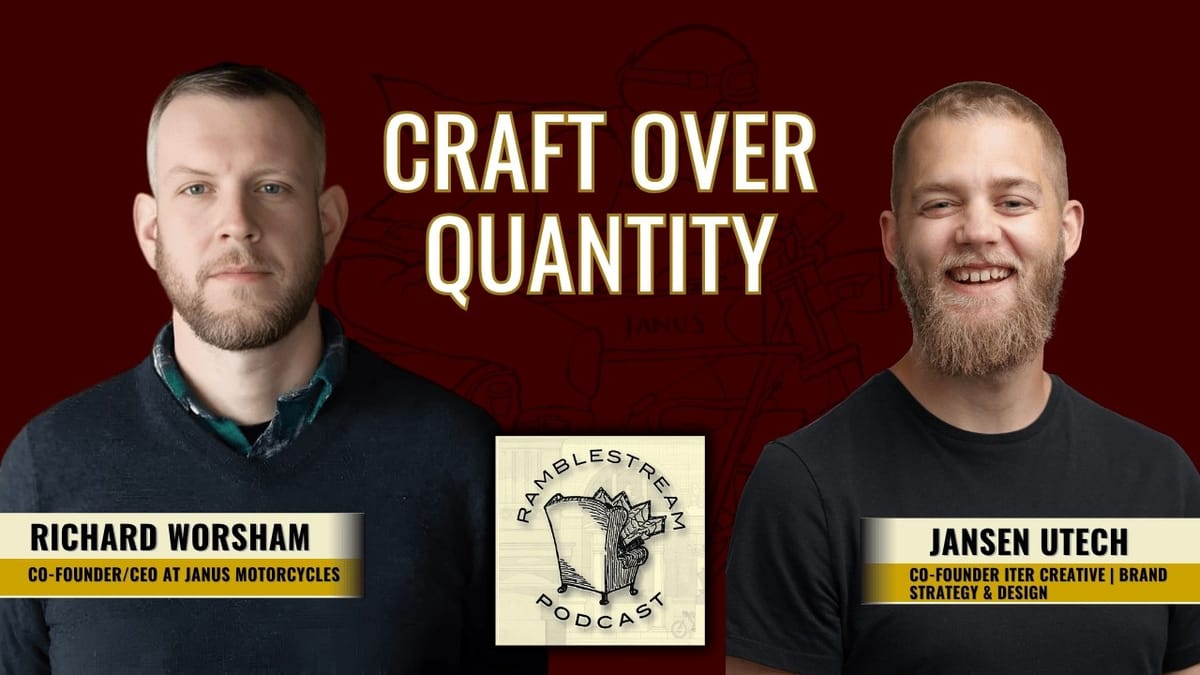
A five-franc coin that can’t buy anything anymore still feels hard to throw away, and that tiny contradiction opens the door to a much bigger question: what do we mean when we say something is “worth it”? We start with an Altoids tin full of old change and end up in the deep water of motorcycle value, where price, performance, and personal meaning rarely line up neatly.
We break value into three big forces that show up in everything riders buy: utility, rarity, and prestige. Utility is the obvious one, but it’s also the most personal, because what you need from a helmet, a pair of boots, or a bike depends on how you actually use it. Rarity gets more interesting in a mass-produced world, where small-batch craft, visible human skill, and a real story can matter as much as specs. Then we wrestle with prestige, from luxury fashion to Rolex, and talk about when brand status is empty marketing versus when it’s supported by history, control, and real quality.
That framework leads straight to a question we hear all the time about Janus Motorcycles: is a $13,000 bike with 14 horsepower too much? If horsepower is your only yardstick, maybe. If you ride for connection, beauty, craftsmanship, and an analog experience with minimal interference between you and the road, the answer changes fast. We make the case for motorcycles built to be felt, not just measured, and why “the best” is often the wrong target compared to “the right.”
Subscribe wherever you listen, share this with a fellow rider, and leave a rating or review so more ramblers can find us.
From livestream #121 - 03/16/26
More About this Episode
The Anatomy of Value: Why We Ride What We Ride
What is a "thing" worth? If you ask a rationalist, they might point to a spreadsheet of specifications, horsepower figures, and material costs. If you ask a collector, they might point to a serial number or a specific year of production. But if you ask a rider, the answer becomes infinitely more complex. Value is rarely a flat line on a graph; it is a multidimensional construct built from utility, rarity, and prestige.
In our most recent discussions at the Ramble Stream studio, we dug into this idea of how we as humans and specifically as motorcyclists ascribe value to the objects in our lives. From a handful of obsolete international coins to the high performance helmets used at the Isle of Man TT, the objects we keep tell a story about what we prioritize. When we look at the motorcycles we build and the way we choose to spend our time on two wheels, it becomes clear that true value isn't found in a spec sheet. It is found in the connection between the machine and the experience of the road.
The Three Pillars of Value
To understand why we value certain objects over others, it helps to break the concept down into three distinct categories: utility, rarity, and prestige. Most objects we interact with fall into one of these buckets, though the most meaningful "things" often bridge the gaps between them.
1. The Utility of Function At its most basic level, value is found in what an object can do for you. This is the realm of the engineer. It is the pair of steel-toed boots that protects your feet on a job site or the helmet that keeps your skull intact during an impact. In a purely rational world, utility should be the only metric that matters.
However, utility is subjective. A $600 racing helmet is incredibly valuable to a track day enthusiast because of its weight, aerodynamics, and safety ratings. To someone who doesn't ride, that same helmet is practically worthless because its function cannot be realized. We see this in the "boots theory" of economics: there is a distinct advantage to being able to afford a high-quality item once rather than buying a cheap version repeatedly. Yet, even within utility, there are layers. You don't need a $400 pair of Red Wings to move a few buckets of paint once a year, but if you are on your feet for ten hours a day, that utility becomes a necessity.
2. The Appeal of Rarity In a modern world dominated by mass production, rarity has taken on a new level of importance. Almost everything we touch is one of millions, stamped out by machines in a process designed for efficiency rather than soul. Because of this, we find ourselves drawn to things that are scarce.
Rarity isn't just about low production numbers; it is about the story of why those numbers are low. Think of a master bladesmith. You could buy a mass-produced sword from a factory, or you could go to a craftsman whose skills have been passed down through generations. When you commission a piece from a craftsman, you aren't just buying steel. You are buying a lineage of knowledge, a year of that person’s life, and a set of intentional decisions that a machine could never make. That rarity breeds desire because it offers something the modern world lacks: a sense of the singular.
3. The Perception of Prestige Then there is prestige, or status. This is the value an object gives you in the eyes of others. A luxury watch or a high-end designer belt often provides the same utility as a budget alternative, but it carries a weight of "having made it."
While it is easy to dismiss prestige as mere vanity, brands like Rolex or Louis Vuitton often back up their status with a history of craftsmanship. They control their production, they maintain a specific lineage, and they offer a level of consistency that builds trust over decades. The danger of prestige is when the brand becomes a caricature of itself, where the item is purchased only for the logo rather than the quality of the "thing" itself.
Redefining the Value of Horsepower
This brings us to a question we hear often in the motorcycle world: Is a specific price tag "too much" for a certain amount of horsepower?
If you view a motorcycle solely through the lens of utility or performance metrics, a 14-horsepower machine might seem like a poor value compared to a high-performance sportbike. But this line of thinking is fundamentally flawed because it values the machine on only one extreme level. It assumes that the goal of every ride is to be the fastest or to lean the furthest.
The true value of a motorcycle isn't found in its top speed; it is found in the "motorcycling" of it. Many riders find that high-performance bikes actually create a barrier between the rider and the environment. When a bike is equipped with traction control, wheelie control, and six different power modes, the machine is doing the riding for you. The "guardrails" of modern technology, while impressive, can wash out the direct, analog response that makes riding a motorcycle so visceral in the first place.
When we talk about motorcycles that emphasize craftsmanship, like those hand-pinstriped by artists who have worked on thousands of tanks, we are talking about a different kind of value. This is the value of the "Toledo sword maker." It is the knowledge that a human being machined the parts, painted the frame, and assembled the engine. That connection to the craft gives the machine a "soul" that mass production simply cannot replicate.
The Return to the Analog
We live in an era where everything is being "smoothed out." Cars are becoming more insulated, motorcycles are becoming more computerized, and the physical connection to our machines is fading. In this landscape, the direct, unmediated experience becomes the rarest commodity of all.
Value, therefore, is found in the distillation of the experience. It is the ability to find a twisty road and enjoy it with a machine that offers a direct response to your input. It is the lack of interference. When you strip away the marketing fluff and the obsession with "more," you are left with the core of why we started riding in the first place: the freedom of the road and the joy of a well-made machine.
True value is rational. It is a calculated decision to prioritize the quality of the experience over the quantity of the specifications. Whether it is a vintage coin kept for thirty years because of the memory it holds or a motorcycle built with intentionality, the things we value most are those that help us feel more connected to the world around us.
Community and the Shared Experience
This philosophy of value extends beyond the machines themselves and into the community we build around them. This is why events like the Rambler’s Roundup or our quarterly Discovery Days are so vital. They aren't just about looking at bikes; they are about the shared stories of people who value the same things.
We’ve shifted our approach to these events to make them more accessible because we recognize that the real "high point" of the year is seeing riders in one place, sharing their experiences. Whether you are a long-time owner or someone just starting to explore the world of small-displacement, handcrafted motorcycles, the value is in the conversation.
We are moving toward a tiered system for our rallies to ensure that anyone who wants to be part of this culture can be. From the "VIP" experience that covers every meal and seminar to a basic ticket that just gets you to the party, the goal is to foster a community that understands that the best things in life aren't mass-produced. They are the things we build together, the roads we travel, and the stories we tell when we finally park the bikes for the night.
In the end, value is what you make of it. You can follow the crowd toward the latest high-tech gadgetry, or you can look for the "pearls" that offer a more meaningful connection. We choose the latter. We choose the craft, the history, and the unfiltered experience of the ride. Because at the end of the day, a motorcycle that "motorcycles better" is worth more than any number on a spec sheet.