
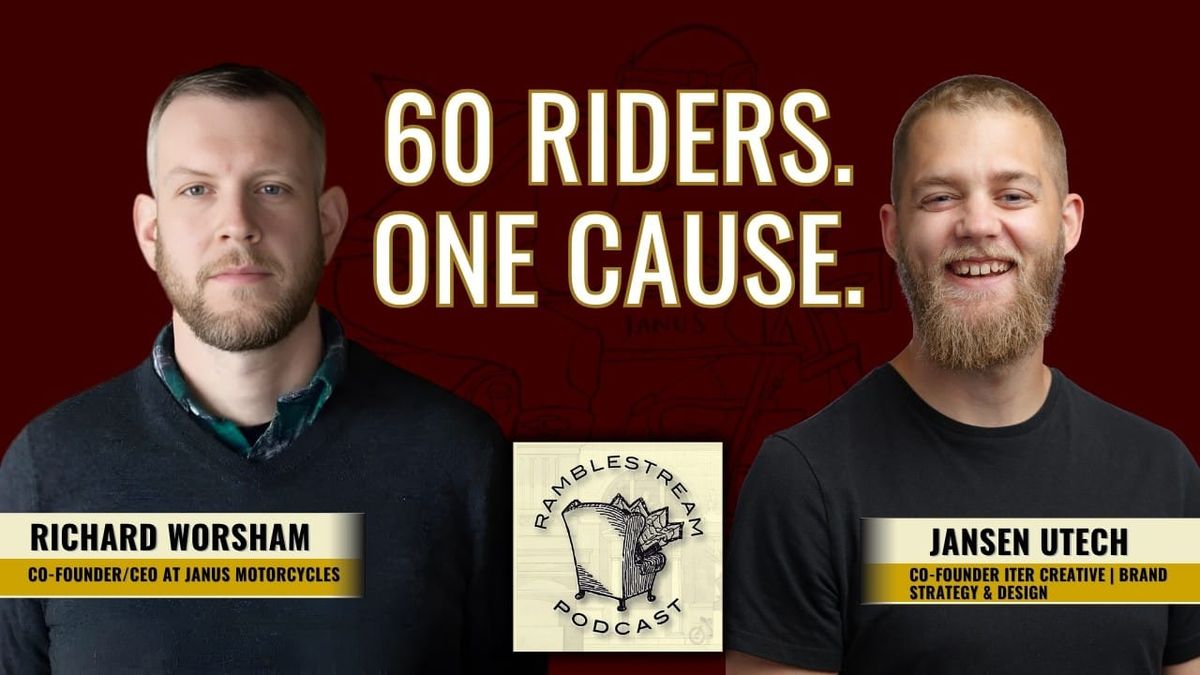
Isolation is a silent profit leak in modern life, shrinking a man's world down to the borders of his routine until he forgets what real connection feels like. When life gets loud with pressure and work, too many people get incredibly good at hiding their struggles behind a stoic face. We sit down to unpack why getting dressed up and riding vintage machines together is the ultimate antidote to that modern isolation.
We get into the technical layout of the shop’s latest custom builds, tracking the specific lines of an indie racing green Phoenix 250 and a satin pewter Halcyon 450 built for the open road. From there, we sit down to talk about the logistics of hosting a massive urban ride, the operational necessity of dedicated road marshals, and the historical grit of George Wyman’s 1903 cross-country journey on a 225cc motor. The secret sauce of this episode is realizing that the polished tanks and vintage shackets are just the staging ground for conversations about men's physical and mental health that too many people avoid until it is too late.
Putting together a massive global event like the Distinguished Gentleman’s Ride isn't just about navigating stoplights and blocking traffic; it’s about breaking down the mental walls that keep guys isolated. You will walk away with a clear blueprint of how mechanical passion can be leveraged to build an intentional, local community that protects its own. It's proof that despite the fracturing of modern life, a real, boots-on-the-ground brotherhood is still very much alive if you know where to look.
More About this Episode
The Challenger Playbook: Why Disruptive Brands Need to Rewrite the Retail Rules
The traditional retail marketing playbook is broken. For decades, the blueprint for scaling a consumer packaged goods brand was relatively straightforward: raise a massive war chest of capital, secure nationwide distribution through sheer economic force, and buy up eye level shelf space alongside prime time media slots. It was an ecosystem built by legacy brands, for legacy brands.
Today, that model is fundamentally failing the modern entrepreneur. Building a brand in the current environment means navigating a landscape defined by rapid technological shifts, fragmented consumer attention, and the meteoric rise of complex retail media networks. For an emerging business, trying to copy the strategy of a multi billion dollar legacy competitor is not just inefficient; it is a fast track to bankruptcy.
True disruption requires a complete shift in mindset. Emerging companies cannot rely on the same resources, logistics networks, or historical leverage as industry giants. They must lean into their inherent advantages, speed, agility, and a close proximity to culture, to carve out sustainable market share. To survive and thrive at modern retail, these disruptive players need an entirely different playbook.
Defining the Modern Challenger Brand
There is a common misconception that scale or revenue defines whether an organization is a market disruptor. People often look at employee count, venture funding, or the number of retail doors a brand occupies. In reality, being a challenger has nothing to do with a specific revenue goal or organizational size. It is entirely defined by a willingness to disrupt a category.
These companies are driven by intense curiosity and a refusal to accept the status quo. They look at stale, commoditized categories and see an opening to do something radically different. Whether it is transforming a basic necessity into an edgy lifestyle statement or bringing artisanal craft to a mass market audience, these brands succeed because they are not afraid to break established industry norms.
Legacy companies often find themselves paralyzed by bureaucracy and layers of political decision making. A challenger, by contrast, operates with an edge. They possess the freedom to experiment, the speed to react to real time market shifts, and the courage to make bold choices that larger competitors simply cannot clear through corporate legal teams.
The Reality of Navigating the Retail Ecosystem
Stepping into the world of mass retail is a jarring experience for many founders. The industry can be incredibly harsh toward newcomers, frequently shunning them for a lack of corporate background or historical sales data. Founders are forced to place massive personal and financial bets with limited resources, a reality that introduces an immense amount of operational pressure.
Because the stakes are so high, a distinct psychological pattern emerges among early stage builders. They become deeply terrified of making a wrong choice. This fear frequently leads to analysis paralysis, where no decision is made at all, or it drives them to blindly copy the tactical missteps of competitors.
Succeeding in this environment requires looking far beyond basic marketing execution. Builders must deeply understand the multi faceted dynamics of the retail environment. This means mastering:
- Retailer Expectations and Margin Structures: Navigating complex cost structures, supply chain requirements, and slotting fees without erasing profitability.
- Velocity and Category Landscape: Understanding exactly how fast a product needs to turn on the shelf to maintain its position against legacy leaders.
- The Retail Media Environment: Recognizing how to strategically invest advertising dollars to drive both immediate digital conversions and long term physical shelf velocity.
Lean, founder led teams frequently wear too many hats simultaneously, acting as CEO, product developer, and head of sales all at once. To scale effectively, they have to move past a piecemeal, tactical mindset. A single trendy channel, such as a TikTok shop or a new artificial intelligence advertising platform, will never fix a flawed business foundation. Long term growth requires a cohesive strategy built on patience, clear brand differentiation, and structural readiness.
The Fallacy of the Universal Retail Strategy
One of the most dangerous traps an emerging brand can fall into is the pursuit of operational efficiency at the expense of strategic relevance. Driven by a lack of resources and strapped for internal capacity, companies often design a single marketing campaign, establish one messaging framework, create a uniform set of assets, and apply that exact plan across their entire retail ecosystem.
If a strategy works everywhere, it is not a strategy.
Every retailer serves a distinct consumer base utilizing a unique shopping format. A consumer interacting with Instacart is in a completely different frame of mind than a member walking the aisles of Costco, Sam's Club, or BJ's. The trip types are different, the basket sizes vary, and the purchasing motivators are entirely distinct.
To win across multiple channels, businesses must meticulously break down the shopper dynamics within each specific ecosystem. They must isolate the precise barriers, motivators, and mindsets driving that specific demographic.
For instance, an online delivery platform requires a hyper focus on immediate convenience and capturing new to brand buyers who are scanning a digital screen. A warehouse club model, however, demands a clear communication of value, family utility, or premium differentiation to justify a bulk investment. Failing to customize the message to fit these unique behavioral patterns is a form of strategic laziness that ultimately dilutes the brand and wastes precious marketing capital.
Analyzing Category Disruption: Lessons from the Field
To fully grasp how modern disruption works in practice, it is valuable to look at real world examples of brands that have successfully rewritten the rules of their respective categories.
Craftsmanship at Mass Scale
Consider the premium coffee space. Historically, moving from a hyper localized, artisanal roasting model into a mass retailer like Walmart meant compromising on brand identity. Traditional thinking dictated that to appeal to a mass market consumer, a premium brand had to genericize its messaging and cut production costs.
The brands that successfully break through this barrier do so by scaling without losing their soul. They scale intentionally and methodically, maintaining a maniacal focus on keeping their core ethos in check. Every single touchpoint, from product quality and packaging design to hospitality and retail storytelling, remains entirely compromised.
These organizations understand that the modern consumer is not just purchasing a functional product from a shelf; they are purchasing an identity and an experience. By maintaining absolute clarity of craft and keeping their message simple, they build profound emotional connections in a category that legacy players treated as a mere commodity.
Transforming the Mundane Through Imagery
On the opposite end of the creative spectrum lies the strategy of injecting extreme edge and hyper visible personality into a historically boring category. For decades, the bottled water aisle was a sea of blue labels, plastic packaging, and repetitive health claims focused on purity and fitness.
Disruption in this space occurred by recognizing a cultural disconnect. Musicians, athletes, and younger consumers wanted the hydration of water but were alienated by the uncool, sterile packaging of traditional brands. By taking water and packaging it in an aluminum can adorned with punk rock graphics and an aggressive, irreverent slogan, a boring necessity was transformed into a highly desirable lifestyle symbol.
The critical insight here is understanding the primary friction point of physical retail: getting a consumer to physically pick up the product. In a crowded aisle, driving raw curiosity is half the battle. By utilizing bold, unexpected visuals, an organization can instantly stand out from traditional competitors. Furthermore, aligning that bold branding with a genuine sustainability message, such as emphasizing the infinitely recyclable nature of aluminum over plastic, satisfies both the consumer's desire for an edgy identity and their ethical preferences.
The lesson for any challenger is clear: do not start a creative brainstorm by asking what is safe or standard. Start by exploring the most extreme, distinctive ideas possible, and figure out how to execute them with structural discipline.
Navigating Macro Shifts and the Future of AI in Advertising
As if navigating the retail shelf were not complex enough, modern brands must also contend with massive technological and macroeconomic shifts. High inflation, rising supply chain costs, and shifting membership fees force consumers to constantly re-evaluate what value means to them. When economic headwinds strike, traditional marketing budgets are often the first area corporate teams cut. For a challenger, this means every single dollar deployed must be foundationally sound.
Simultaneously, the rapid monetization of artificial intelligence platforms is introducing uncharted territory into performance marketing. Major language models and AI platforms are transitioning from impression based advertising models to performance based, cost per click structures.
This evolution represents a massive opportunity for hyper contextual targeting. Traditional search is transactional; users type in a specific keyword and expect a direct product match. AI chat interactions, however, are highly conversational and emotional. People use these platforms to navigate messy, real world scenarios, such as asking for a custom recipe based on random ingredients left in their refrigerator or planning a complex family itinerary.
While this technology promises to eventually place brands directly into the consumer's decision making matrix, the current landscape remains incredibly clunky. Platforms are still learning how to read subtle contextual cues without interrupting the user experience with disruptive, poorly timed ads.
For an emerging brand, diving headfirst into highly experimental AI ad platforms is a mistake. The foundational elements must be locked in first. Before worrying about emerging digital ad channels, a business must ensure its core brand identity is unmistakable, its product messaging is razor sharp, its customer reviews are robust, and its search engine optimization is entirely secured.
The Path Forward for Innovators
We are entering one of the most exciting eras for market disruption. Modern consumers are deeply fatigued by generic content, corporate consolidation, and sterile brand experiences. They are actively craving brands that feel human driven, intentional, and intimately connected to their real lives.
Because emerging brands operate closer to culture, they possess a monumental advantage over slow moving corporate giants. They can listen faster, pivot sooner, and build genuine, transparent communities.
The ultimate guidance for any founder or builder navigating this space is simple: do not try to act like a legacy brand. Do not dilute your uniqueness in a misguided attempt to mimic the scale of a multi billion dollar competitor.
Clarity will always beat complexity. In the long run, building a deep, authentic emotional relationship with your core consumer matters far more than achieving rapid, uncoordinated distribution scale. Keep your strategies intentional, lean into your operational agility, and ensure that every single tactic you execute connects directly back to solving a real, meaningful problem for your consumer.